Bi-Fold Shutters For Outdoor Living: Creating Seamless Balcony & Patio Spaces On The Sunshine Coast
Balcony Shutters Australia • August 12, 2026
Bi-fold shutters for outdoor entertaining areas solve a specific problem: how to open a balcony or patio right up to the elements on a good day, then seal it against wind, sun and driving rain the moment conditions turn. Unlike fixed screens or single-panel systems, bi-fold shutters stack neatly to either side, giving you a fully retractable wall of protection that disappears when you don't need it.
For Sunshine Coast homes and apartments, that flexibility isn't a luxury add-on – it's a practical response to a climate that swings between glorious outdoor days and sudden coastal weather changes.
What Are Bi-Fold Shutters & How Do They Work
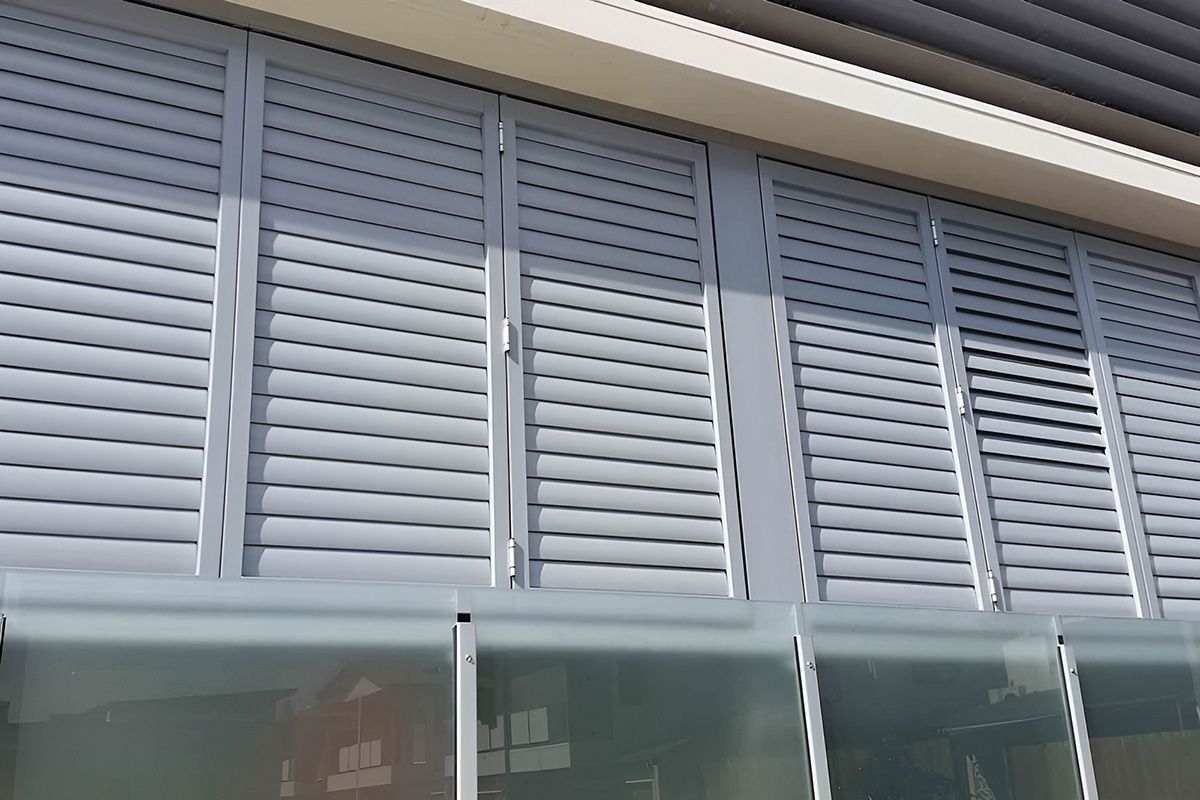
Bi-fold shutters are made up of two hinged aluminium panels that fold back on themselves and stack to either side of an opening, similar in principle to bi-fold doors but purpose-built for external, weather-facing applications. Panels are hinged together in pairs, running along a top and bottom track so the whole system glides smoothly rather than relying on individual sliding panels.
When closed, the panels sit flush and interlock to form a continuous weatherproof barrier. When opened, they fold back in a compact stack, leaving the opening almost entirely clear. This is the key difference between bi-fold shutters and simpler screening options: you get a genuine full-width opening, not just a partial gap.
External aluminium bi-fold shutters are engineered specifically for this movement under outdoor conditions, factoring in wind load, thermal expansion and the repeated opening and closing that a well-used balcony or patio sees over years of use.
Why Bi-Fold Shutters Suit Balconies, Patios & Outdoor Entertaining Areas
Balconies and patios are transitional spaces. They're not fully indoors, not fully exposed and the best outdoor living setups treat them that way, as an area that can flex between open-air entertaining and fully enclosed shelter depending on the day.
Bi-fold shutters for balconies work well here because they don't force a single-use outcome. A north-facing balcony can be thrown open for afternoon entertaining, then closed off entirely if a southerly change rolls through later that evening. A patio used for outdoor dining can be shielded from harsh midday sun without losing the option to open it fully for an evening barbecue.
Example: A homeowner in Mooloolaba with a covered patio off the kitchen wanted a space usable year-round, sheltered from summer storms, but not closed in like a sunroom. Bi-fold shutters installed along the open side let the family fold them back completely for weekend gatherings, then close them fully during wet season without losing the outdoor feel of the space.
Creating a Seamless Indoor-Outdoor Flow Without Losing Weather Protection
One of the main reasons homeowners look at bi-fold shutters for outdoor entertaining areas is the way they extend the usable footprint of a home. When fully open, a bi-fold shutter system creates a visual and physical connection between an indoor living area and the balcony or patio beyond it – the kind of flow renovators and builders are often trying to achieve with larger glazing or open-plan layouts.
The difference is that this flow doesn't come at the cost of protection. Where an open patio or unscreened balcony leaves furniture, flooring and fittings exposed to sun damage and wind-driven rain, a closed bi-fold shutter system provides a genuine barrier. This means outdoor furniture, timber decking and soft furnishings face less exposure to UV and moisture, which matters over the long term on any coastal property.
For builders and renovators working on outdoor living upgrades, this dual function – open for connection, closed for protection – is often the deciding factor between shutters and simpler alternatives like fixed louvres or annual blinds.
Bi-Fold Shutters for Apartments & High-Rise Balconies
Outdoor bi-fold shutters on an apartment balcony face a different set of demands to a ground-floor patio. Height increases wind exposure, balcony footprints are usually smaller and body corporate or building design guidelines often restrict what can be installed on the exterior of a multi-residential building.
Bi-fold shutters suit this environment because they don't require significant floor space to operate – the panels stack neatly against the balustrade or wall rather than swinging outward or requiring deep recess pockets. For apartment owners, this means the balcony stays fully usable whether the shutters are open or closed.
Property developers on multi-residential coastal projects increasingly specify bi-fold shutter systems at the design stage for exactly this reason: they add weather protection and privacy to smaller balconies without compromising the sightlines or usable area that make apartment living appealing in the first place.
Materials & Finishes Built for Coastal Conditions (Sun, Wind, Salt Air)
Any external shutter product on the Sunshine Coast has to deal with three things at once: intense UV exposure, salt-laden air and wind loads that vary sharply between a sheltered courtyard and an exposed high-rise balcony. Weatherproof bi-fold shutters are built with this combination in mind, not adapted from an indoor product range.
Aluminium is the standard material choice for coastal applications because it doesn't rust, warp or rot the way timber-look alternatives can under sustained salt air exposure. Powder-coated finishes add a further layer of UV and corrosion resistance, and are available in a range of colours to match modern coastal or contemporary home exteriors.
According to industry best practice for coastal exterior products, hardware components – hinges, tracks and locking mechanisms – should also be corrosion-resistant, since these are usually the first point of failure in lower-quality external shutter systems exposed to salt air over time.
Bi-Fold Vs Sliding Vs Stacking Shutters – Which Suits Your Outdoor Space
Choosing between bi-fold, sliding and stacking shutters comes down to the shape of the opening, the available stacking space and how the area is used day to day.
- Bi-fold shutters suit wide openings where a full, unobstructed opening is the priority, ideal for entertaining areas where you want the balcony or patio to feel completely open when in use.
- Sliding shutters work well where panels need to move independently, such as covering only part of an opening while leaving the rest exposed.
- Stacking shutters are often chosen for very wide or continuous runs, where panels stack to one side in a single direction rather than folding back on themselves.
For most balcony and patio entertaining areas, bi-fold shutters offer the best balance of a genuinely open outlook when retracted and a solid, continuous weatherproof seal when closed, which is why they're a common choice over sliding systems in outdoor living upgrades.
Getting Started: What to Consider Before Installing Bi-Fold Shutters
Before installing bi-fold shutters, it's worth working through a few practical questions rather than choosing a system based on appearance alone:
- Opening width and stacking space – confirm there's enough room to one or both sides for the panels to stack when fully open.
- Wind exposure – a ground-floor courtyard and a tenth-floor balcony have very different wind load requirements, which affects panel engineering and track selection.
- Building or body corporate requirements – apartment and multi-residential owners should check any design guidelines before committing to a system.
- Intended use – an entertaining-focused patio may prioritise a fully open outlook, while a balcony used more for storage or drying may prioritise security and enclosure.
Working through these factors with a supplier experienced in coastal installations makes it far easier to land on a system that suits both the space and the way it's actually going to be used. Contact Balcony Shutters Australia to learn more.
Frequently Asked Questions
Do bi-fold shutters work on small apartment balconies?
Yes. Bi-fold shutters are well-suited to smaller balconies because the panels stack compactly to one side rather than requiring deep recess space, which helps preserve the usable floor area on a compact apartment balcony.
Are external bi-fold shutters strong enough for coastal wind conditions?
Aluminium bi-fold shutters are engineered to account for wind load, and higher, more exposed installations are typically specified with this in mind. It's worth confirming wind rating requirements with your supplier based on the specific height and exposure of your balcony or patio.
Can bi-fold shutters be fully opened, or do they always sit partly closed?
Bi-fold shutters can be fully opened, with all panels folding back to one side to leave the opening almost entirely clear. This is one of the main reasons they're chosen for entertaining areas over fixed or partial-coverage screening.
What's the difference between bi-fold and sliding shutters?
Bi-fold shutters stack together in pairs as they are opened, giving a fully clear opening, while sliding shutters move panels independently along a track, which can leave part of the opening covered even when ‘open’. The right choice depends on the shape of your space and how you use it.
Do bi-fold shutters suit both new builds and renovations?
Yes. Bi-fold shutters can be specified at the design stage for new builds and multi-residential developments, or retrofitted to existing balconies and patios during a renovation, provided there's suitable stacking space to one side of the opening.
Will bi-fold shutters fade or corrode in coastal conditions?
Quality aluminium bi-fold shutters with a powder-coated finish are built to resist UV fading and salt-air corrosion. According to industry best practice, checking the corrosion resistance of hinges and track hardware – not just the panels – is important for long-term coastal durability.